Wednesday, March 21, 2018

Word Wide Open: Palm Sunday (B)


First Reading (Isaiah 50:4-7)

The Lord GOD has given me
a well-trained tongue,
that I might know how to speak to the weary
a word that will rouse them.
Morning after morning
he opens my ear that I may hear;
and I have not rebelled,
have not turned back.
I gave my back to those who beat me,
my cheeks to those who plucked my beard;
my face I did not shield
from buffets and spitting.

The Lord GOD is my help,
therefore I am not disgraced;
I have set my face like flint,
knowing that I shall not be put to shame.

Asking the big questions: Is there anything that stuck out to you from this reading? Why should we turn the other cheek when others persecute us? How can we speak to weary as well?


Responsorial Pslam (Psalm 22:8-9, 17-18, 19-20, 23-24)

R. (2a) My God, my God, why have you abandoned me?
All who see me scoff at me;
they mock me with parted lips, they wag their heads:
"He relied on the LORD; let him deliver him,
let him rescue him, if he loves him."
R. My God, my God, why have you abandoned me?
Indeed, many dogs surround me,
a pack of evildoers closes in upon me;
They have pierced my hands and my feet;
I can count all my bones.
R. My God, my God, why have you abandoned me?
They divide my garments among them,
and for my vesture they cast lots.
But you, O LORD, be not far from me;
O my help, hasten to aid me.
R. My God, my God, why have you abandoned me?
I will proclaim your name to my brethren;
in the midst of the assembly I will praise you:
"You who fear the LORD, praise him;
all you descendants of Jacob, give glory to him;
revere him, all you descendants of Israel!"
R. My God, my God, why have you abandoned me?


Second Reading (Philippians 2:6-11)


Christ Jesus, though he was in the form of God,
did not regard equality with God
something to be grasped.
Rather, he emptied himself,
taking the form of a slave,
coming in human likeness;
and found human in appearance,
he humbled himself,
becoming obedient to the point of death,
even death on a cross.
Because of this, God greatly exalted him
and bestowed on him the name
which is above every name,
that at the name of Jesus
every knee should bend,
of those in heaven and on earth and under the earth,
and every tongue confess that
Jesus Christ is Lord,
to the glory of God the Father.

Asking the big questions: Is there anything that stuck out to you from this reading? Is St. Paul saying Jesus was not God? Why is Christ's obedience so powerful? 


Gospel (Mark 15:1-39) abridged version

As soon as morning came,
the chief priests with the elders and the scribes,
that is, the whole Sanhedrin held a council.
They bound Jesus, led him away, and handed him over to Pilate.
Pilate questioned him,
"Are you the king of the Jews?"
He said to him in reply, "You say so."
The chief priests accused him of many things.
Again Pilate questioned him,
"Have you no answer?
See how many things they accuse you of."
Jesus gave him no further answer, so that Pilate was amazed.

Now on the occasion of the feast he used to release to them
one prisoner whom they requested.
A man called Barabbas was then in prison
along with the rebels who had committed murder in a rebellion.
The crowd came forward and began to ask him
to do for them as he was accustomed.
Pilate answered,
"Do you want me to release to you the king of the Jews?"
For he knew that it was out of envy
that the chief priests had handed him over.
But the chief priests stirred up the crowd
to have him release Barabbas for them instead.
Pilate again said to them in reply,
"Then what do you want me to do
with the man you call the king of the Jews?"
They shouted again, "Crucify him."
Pilate said to them, "Why? What evil has he done?"
They only shouted the louder, "Crucify him."
So Pilate, wishing to satisfy the crowd,
released Barabbas to them and, after he had Jesus scourged,
handed him over to be crucified.

The soldiers led him away inside the palace,
that is, the praetorium, and assembled the whole cohort.
They clothed him in purple and,
weaving a crown of thorns, placed it on him.
They began to salute him with, "Hail, King of the Jews!"
and kept striking his head with a reed and spitting upon him.
They knelt before him in homage.
And when they had mocked him,
they stripped him of the purple cloak,
dressed him in his own clothes,
and led him out to crucify him.

They pressed into service a passer-by, Simon,
a Cyrenian, who was coming in from the country,
the father of Alexander and Rufus,
to carry his cross.

They brought him to the place of Golgotha
—which is translated Place of the Skull —
They gave him wine drugged with myrrh,
but he did not take it.
Then they crucified him and divided his garments
by casting lots for them to see what each should take.
It was nine o'clock in the morning when they crucified him.
The inscription of the charge against him read,
"The King of the Jews."
With him they crucified two revolutionaries,
one on his right and one on his left.
Those passing by reviled him,
shaking their heads and saying,
"Aha! You who would destroy the temple
and rebuild it in three days,
save yourself by coming down from the cross."
Likewise the chief priests, with the scribes,
mocked him among themselves and said,
"He saved others; he cannot save himself.
Let the Christ, the King of Israel,
come down now from the cross
that we may see and believe."
Those who were crucified with him also kept abusing him.

At noon darkness came over the whole land
until three in the afternoon.
And at three o'clock Jesus cried out in a loud voice,
"Eloi, Eloi, lema sabachthani?"
which is translated,
"My God, my God, why have you forsaken me?"
Some of the bystanders who heard it said,
"Look, he is calling Elijah."
One of them ran, soaked a sponge with wine, put it on a reed
and gave it to him to drink saying,
"Wait, let us see if Elijah comes to take him down."
Jesus gave a loud cry and breathed his last.

Here all kneel and pause for a short time.

The veil of the sanctuary was torn in two from top to bottom.
When the centurion who stood facing him
saw how he breathed his last he said,
"Truly this man was the Son of God!"

Asking the big questions: Is there anything that stuck out to you from this Gospel reading? What are ways that we deny the Lord like Peter? How does Christ's suffering show us how to handle our own? How should we respond to those who persecute us?


SIGN UP FOR CHRISTPOWER 2018 TODAY!

SIGN UP FOR THE 2018 STEUBENVILLE CONFERENCE TODAY! (spots are limited)

Wednesday, March 14, 2018

Word Wide Open: The Fifth Sunday of Lent (B)


First Reading (Jeremiah 31:31-34)

The days are coming, says the LORD, 
when I will make a new covenant with the house of Israel 
and the house of Judah.
It will not be like the covenant I made with their fathers
the day I took them by the hand 
to lead them forth from the land of Egypt; 
for they broke my covenant, 
and I had to show myself their master, says the LORD.
But this is the covenant that I will make 
with the house of Israel after those days, says the LORD.
I will place my law within them and write it upon their hearts; 
I will be their God, and they shall be my people.
No longer will they have need to teach their friends and relatives
how to know the LORD.
All, from least to greatest, shall know me, says the LORD, 
for I will forgive their evildoing and remember their sin no more.

Asking the big questions: Is there anything that stuck out to you from this reading? What is the difference between the old and new covenant? What does it mean to know the Lord? How can we know Him?


Responsorial Pslam (Psalm 51:3-4, 12-13, 14-15)

R. (12a) Create a clean heart in me, O God.
Have mercy on me, O God, in your goodness;
in the greatness of your compassion wipe out my offense.
Thoroughly wash me from my guilt
and of my sin cleanse me.
R. Create a clean heart in me, O God.
A clean heart create for me, O God,
and a steadfast spirit renew within me.
Cast me not out from your presence,
and your Holy Spirit take not from me.
R. Create a clean heart in me, O God.
Give me back the joy of your salvation,
and a willing spirit sustain in me.
I will teach transgressors your ways,
and sinners shall return to you.
R. Create a clean heart in me, O God.


Second Reading (Hebrews 5:7-9)

In the days when Christ Jesus was in the flesh,
he offered prayers and supplications with loud cries and tears
to the one who was able to save him from death,
and he was heard because of his reverence.
Son though he was, he learned obedience from what he suffered;
and when he was made perfect,
he became the source of eternal salvation for all who obey him.

Asking the big questions: Is there anything that stuck out to you from this reading? Why is obedience so important? Why does the world reject the idea of obedience? How does God honor our obedience?


Gospel (John 12:20-33)

Some Greeks who had come to worship at the Passover Feast
came to Philip, who was from Bethsaida in Galilee,
and asked him, "Sir, we would like to see Jesus."
Philip went and told Andrew;
then Andrew and Philip went and told Jesus.
Jesus answered them,
"The hour has come for the Son of Man to be glorified.
Amen, amen, I say to you,
unless a grain of wheat falls to the ground and dies,
it remains just a grain of wheat;
but if it dies, it produces much fruit.
Whoever loves his life loses it,
and whoever hates his life in this world
will preserve it for eternal life.
Whoever serves me must follow me,
and where I am, there also will my servant be.
The Father will honor whoever serves me.

"I am troubled now. Yet what should I say?
'Father, save me from this hour'?
But it was for this purpose that I came to this hour.
Father, glorify your name."
Then a voice came from heaven,
"I have glorified it and will glorify it again."
The crowd there heard it and said it was thunder;
but others said, "An angel has spoken to him."
Jesus answered and said,
"This voice did not come for my sake but for yours.
Now is the time of judgment on this world;
now the ruler of this world will be driven out.
And when I am lifted up from the earth,
I will draw everyone to myself."
He said this indicating the kind of death he would die.

Asking the big questions: Is there anything that stuck out to you from this Gospel reading? What does it mean to "hate" your life? Why is death required to bring about life? How will Jesus draw everyone to Himself? 


SIGN UP FOR CHRISTPOWER 2018 TODAY!

SIGN UP FOR THE 2018 STEUBENVILLE CONFERENCE TODAY! (spots are limited)

Wednesday, March 7, 2018

Word Wide Open: The Fourth Sunday of Lent (B)


First Reading (2 Chronicles 36:14-16, 19-23)

In those days, all the princes of Judah, the priests, and the people 
added infidelity to infidelity, 
practicing all the abominations of the nations 
and polluting the LORD’s temple 
which he had consecrated in Jerusalem.

Early and often did the LORD, the God of their fathers, 
send his messengers to them, 
for he had compassion on his people and his dwelling place.
But they mocked the messengers of God, 
despised his warnings, and scoffed at his prophets, 
until the anger of the LORD against his people was so inflamed 
that there was no remedy.
Their enemies burnt the house of God,
tore down the walls of Jerusalem, 
set all its palaces afire, 
and destroyed all its precious objects.
Those who escaped the sword were carried captive to Babylon, 
where they became servants of the king of the Chaldeans and his sons
until the kingdom of the Persians came to power.
All this was to fulfill the word of the LORD spoken by Jeremiah: 
“Until the land has retrieved its lost sabbaths, 
during all the time it lies waste it shall have rest 
while seventy years are fulfilled.”

In the first year of Cyrus, king of Persia, 
in order to fulfill the word of the LORD spoken by Jeremiah, 
the LORD inspired King Cyrus of Persia 
to issue this proclamation throughout his kingdom, 
both by word of mouth and in writing: 
“Thus says Cyrus, king of Persia: 
All the kingdoms of the earth
the LORD, the God of heaven, has given to me, 
and he has also charged me to build him a house 
in Jerusalem, which is in Judah.
Whoever, therefore, among you belongs to any part of his people, 
let him go up, and may his God be with him!”


Asking the big questions: Is there anything that stuck out to you from this reading? How does sin "pollute" our bodily temple? Who are the messengers of the Lord that are often rejected? How can we be those messengers?

Responsorial Pslam (Psalm 137:1-2, 3, 4-5, 6)

R. (6ab) Let my tongue be silenced, if I ever forget you!
By the streams of Babylon
we sat and wept
when we remembered Zion.
On the aspens of that land
we hung up our harps.
R. Let my tongue be silenced, if I ever forget you!
For there our captors asked of us
the lyrics of our songs,
And our despoilers urged us to be joyous:
“Sing for us the songs of Zion!”
R. Let my tongue be silenced, if I ever forget you!
How could we sing a song of the LORD
in a foreign land?
If I forget you, Jerusalem,
may my right hand be forgotten!
R. Let my tongue be silenced, if I ever forget you!
May my tongue cleave to my palate
if I remember you not,
If I place not Jerusalem
ahead of my joy.
R. Let my tongue be silenced, if I ever forget you!


Second Reading (Ephesians 2:4-10)

Brothers and sisters:
God, who is rich in mercy,
because of the great love he had for us,
even when we were dead in our transgressions,
brought us to life with Christ — by grace you have been saved —,
raised us up with him,
and seated us with him in the heavens in Christ Jesus,
that in the ages to come
He might show the immeasurable riches of his grace
in his kindness to us in Christ Jesus.
For by grace you have been saved through faith,
and this is not from you; it is the gift of God;
it is not from works, so no one may boast.
For we are his handiwork, created in Christ Jesus for the good works
that God has prepared in advance,
that we should live in them.

Asking the big questions: Is there anything that stuck out to you from this reading? Is St. Paul saying we do not have to do good works? Can we earn salvation? Can we lose our salvation?


Gospel (John 3:14-21)

Jesus said to Nicodemus:
“Just as Moses lifted up the serpent in the desert,
so must the Son of Man be lifted up,
so that everyone who believes in him may have eternal life.”

For God so loved the world that he gave his only Son,
so that everyone who believes in him might not perish
but might have eternal life.
For God did not send his Son into the world to condemn the world,
but that the world might be saved through him.
Whoever believes in him will not be condemned,
but whoever does not believe has already been condemned,
because he has not believed in the name of the only Son of God.
And this is the verdict,
that the light came into the world,
but people preferred darkness to light,
because their works were evil.
For everyone who does wicked things hates the light
and does not come toward the light,
so that his works might not be exposed.
But whoever lives the truth comes to the light,
so that his works may be clearly seen as done in God.

Asking the big questions: Is there anything that stuck out to you from this Gospel reading? How does believing in Jesus give us eternal life? What are ways we contribute to the light in the world? Why are wicked things always in the dark?


SIGN UP FOR CHRISTPOWER 2018 TODAY!

SIGN UP FOR THE 2018 STEUBENVILLE CONFERENCE TODAY! (spots are limited)

Wednesday, February 28, 2018

Word Wide Open: The Third Sunday of Lent (B)


First Reading (Exodus 20:1-17)

In those days, God delivered all these commandments:
"I, the LORD, am your God, 
who brought you out of the land of Egypt, that place of slavery.
You shall not have other gods besides me.
You shall not carve idols for yourselves 
in the shape of anything in the sky above 
or on the earth below or in the waters beneath the earth; 
you shall not bow down before them or worship them.
For I, the LORD, your God, am a jealous God, 
inflicting punishment for their fathers' wickedness 
on the children of those who hate me, 
down to the third and fourth generation; 
but bestowing mercy down to the thousandth generation 
on the children of those who love me and keep my commandments.

"You shall not take the name of the LORD, your God, in vain.
For the LORD will not leave unpunished 
the one who takes his name in vain.

"Remember to keep holy the sabbath day.
Six days you may labor and do all your work, 
but the seventh day is the sabbath of the LORD, your God.
No work may be done then either by you, or your son or daughter, 
or your male or female slave, or your beast, 
or by the alien who lives with you.
In six days the Lord made the heavens and the earth, 
the sea and all that is in them; 
but on the seventh day he rested.
That is why the LORD has blessed the sabbath day and made it holy.

"Honor your father and your mother, 
that you may have a long life in the land 
which the LORD, your God, is giving you.
You shall not kill.
You shall not commit adultery.
You shall not steal.
You shall not bear false witness against your neighbor.
You shall not covet your neighbor's house.
You shall not covet your neighbor's wife, 
nor his male or female slave, nor his ox or ass, 
nor anything else that belongs to him."

Asking the big questions: Is there anything that stuck out to you from this reading? Why did God give the Israelites the 10 Commandments? How are they not just rules? What would you say to someone that claims that Catholics have too many "rules?"


Responsorial Pslam (Psalm 19:8, 9, 10, 11)

R. (John 6:68c) Lord, you have the words of everlasting life.
The law of the LORD is perfect,
refreshing the soul;
The decree of the LORD is trustworthy,
giving wisdom to the simple.
R. Lord, you have the words of everlasting life.
The precepts of the LORD are right,
rejoicing the heart;
the command of the LORD is clear,
enlightening the eye.
R. Lord, you have the words of everlasting life.
The fear of the LORD is pure,
enduring forever;
the ordinances of the LORD are true,
all of them just.
R. Lord, you have the words of everlasting life.
They are more precious than gold,
than a heap of purest gold;
sweeter also than syrup
or honey from the comb.

R. Lord, you have the words of everlasting life.


Second Reading (1 Corinthians 1:22-25)

Brothers and sisters:
Jews demand signs and Greeks look for wisdom,
but we proclaim Christ crucified,
a stumbling block to Jews and foolishness to Gentiles,
but to those who are called, Jews and Greeks alike,
Christ the power of God and the wisdom of God.
For the foolishness of God is wiser than human wisdom,
and the weakness of God is stronger than human strength.

Asking the big questions: Is there anything that stuck out to you from this reading? How can we see God working in our lives? Why do we lose trust in God and His ways?


Gospel (John 2:13-25)

Since the Passover of the Jews was near,
Jesus went up to Jerusalem.
He found in the temple area those who sold oxen, sheep, and doves,
as well as the money changers seated there.
He made a whip out of cords
and drove them all out of the temple area, with the sheep and oxen,
and spilled the coins of the money changers
and overturned their tables,
and to those who sold doves he said,
"Take these out of here,
and stop making my Father's house a marketplace."
His disciples recalled the words of Scripture,
Zeal for your house will consume me.
At this the Jews answered and said to him,
"What sign can you show us for doing this?"
Jesus answered and said to them,
"Destroy this temple and in three days I will raise it up."
The Jews said,
"This temple has been under construction for forty-six years,
and you will raise it up in three days?"
But he was speaking about the temple of his body.
Therefore, when he was raised from the dead,
his disciples remembered that he had said this,
and they came to believe the Scripture
and the word Jesus had spoken.

While he was in Jerusalem for the feast of Passover,
many began to believe in his name
when they saw the signs he was doing.
But Jesus would not trust himself to them because he knew them all,
and did not need anyone to testify about human nature.
He himself understood it well.

Asking the big questions: Is there anything that stuck out to you from this Gospel reading? Why did Jesus react this way? What is Christ referring to about the temple? How do we sometimes go through the motions and not dive deeper into our faith?


SIGN UP FOR CHRISTPOWER 2018 TODAY!

SIGN UP FOR THE 2018 STEUBENVILLE CONFERENCE TODAY! (spots are limited)

Wednesday, February 21, 2018

Word Wide Open: The Second Sunday of Lent (B)


First Reading (Genesis 22:1-2, 9A, 10-13, 15-18)

God put Abraham to the test.
He called to him, "Abraham!"
"Here I am!" he replied.
Then God said:
"Take your son Isaac, your only one, whom you love, 
and go to the land of Moriah.
There you shall offer him up as a holocaust 
on a height that I will point out to you."

When they came to the place of which God had told him, 
Abraham built an altar there and arranged the wood on it.
Then he reached out and took the knife to slaughter his son.
But the LORD's messenger called to him from heaven, 
"Abraham, Abraham!"
"Here I am!" he answered.
"Do not lay your hand on the boy," said the messenger.
"Do not do the least thing to him.
I know now how devoted you are to God, 
since you did not withhold from me your own beloved son."
As Abraham looked about, 
he spied a ram caught by its horns in the thicket.
So he went and took the ram 
and offered it up as a holocaust in place of his son.

Again the LORD's messenger called to Abraham from heaven and said: 
"I swear by myself, declares the LORD, 
that because you acted as you did 
in not withholding from me your beloved son, 
I will bless you abundantly 
and make your descendants as countless 
as the stars of the sky and the sands of the seashore; 
your descendants shall take possession 
of the gates of their enemies, 
and in your descendants all the nations of the earth
shall find blessing—
all this because you obeyed my command."

Asking the big questions: Is there anything that stuck out to you from this reading? Why did God test Abraham in this way? How do we withhold things from God? In what ways is the coming of Christ and His passion a direct answer to this passage?


Responsorial Pslam (Psalm 116:10, 15, 16-17, 18-19)

R. (116:9) I will walk before the Lord, in the land of the living.
I believed, even when I said,
"I am greatly afflicted."
Precious in the eyes of the LORD
is the death of his faithful ones.
R. I will walk before the Lord, in the land of the living.
O LORD, I am your servant;
I am your servant, the son of your handmaid;
you have loosed my bonds.
To you will I offer sacrifice of thanksgiving,
and I will call upon the name of the LORD.
R. I will walk before the Lord, in the land of the living.
My vows to the LORD I will pay
in the presence of all his people,
In the courts of the house of the LORD,
in your midst, O Jerusalem.
R. I will walk before the Lord, in the land of the living.


Second Reading (Romans 8:31B-34)

Brothers and sisters:
If God is for us, who can be against us?
He who did not spare his own Son
but handed him over for us all,
how will he not also give us everything else along with him?

Who will bring a charge against God's chosen ones?
It is God who acquits us, who will condemn?
Christ Jesus it is who died—or, rather, was raised—
who also is at the right hand of God,
who indeed intercedes for us.

Asking the big questions: Is there anything that stuck out to you from this reading? Why do you think there is division among Christians? Did God truly give us everything? How?

Gospel (Mark 9:2-10)

Jesus took Peter, James, and John
and led them up a high mountain apart by themselves.
And he was transfigured before them,
and his clothes became dazzling white,
such as no fuller on earth could bleach them.
Then Elijah appeared to them along with Moses,
and they were conversing with Jesus.
Then Peter said to Jesus in reply,
"Rabbi, it is good that we are here!
Let us make three tents:
one for you, one for Moses, and one for Elijah."
He hardly knew what to say, they were so terrified.
Then a cloud came, casting a shadow over them;
from the cloud came a voice,
"This is my beloved Son. Listen to him."
Suddenly, looking around, they no longer saw anyone
but Jesus alone with them.

As they were coming down from the mountain,
he charged them not to relate what they had seen to anyone,
except when the Son of Man had risen from the dead.
So they kept the matter to themselves,
questioning what rising from the dead meant.

Asking the big questions: Is there anything that stuck out to you from this Gospel reading? Why couldn't they stay on top of the mountain? What are some mountain top experiences we have? How can we make sure those experiences change our lives?


SIGN UP FOR CHRISTPOWER 2018 TODAY!

SIGN UP FOR THE 2018 STEUBENVILLE CONFERENCE TODAY! (spots are limited)

Wednesday, February 14, 2018

Word Wide Open: The First Sunday of Lent (B)


First Reading (Genesis 9:8-15)

God said to Noah and to his sons with him: 
"See, I am now establishing my covenant with you 
and your descendants after you 
and with every living creature that was with you: 
all the birds, and the various tame and wild animals 
that were with you and came out of the ark.
I will establish my covenant with you, 
that never again shall all bodily creatures be destroyed
by the waters of a flood; 
there shall not be another flood to devastate the earth."
God added:
"This is the sign that I am giving for all ages to come, 
of the covenant between me and you 
and every living creature with you: 
I set my bow in the clouds to serve as a sign
of the covenant between me and the earth.
When I bring clouds over the earth, 
and the bow appears in the clouds, 
I will recall the covenant I have made
between me and you and all living beings, 
so that the waters shall never again become a flood 
to destroy all mortal beings."

Asking the big questions: Is there anything that stuck out to you from this reading? What is a covenant? What other times has God made covenants with mankind? How do we know that thee covenants have been fulfilled?


Responsorial Pslam (Psalm 25:4-5, 6-7, 8-9)

R. (cf. 10) Your ways, O Lord, are love and truth to those who keep your covenant.
Your ways, O LORD, make known to me;
teach me your paths,
Guide me in your truth and teach me,
for you are God my savior.
R. Your ways, O Lord, are love and truth to those who keep your covenant.
Remember that your compassion, O LORD,
and your love are from of old.
In your kindness remember me,
because of your goodness, O LORD.
R. Your ways, O Lord, are love and truth to those who keep your covenant.
Good and upright is the LORD,
thus he shows sinners the way.
He guides the humble to justice,
and he teaches the humble his way.
R. Your ways, O Lord, are love and truth to those who keep your covenant.


Second Reading (1 Peter 3:18-22)

Beloved:
Christ suffered for sins once,
the righteous for the sake of the unrighteous,
that he might lead you to God.
Put to death in the flesh,
he was brought to life in the Spirit.
In it he also went to preach to the spirits in prison,
who had once been disobedient
while God patiently waited in the days of Noah
during the building of the ark,
in which a few persons, eight in all,
were saved through water.
This prefigured baptism, which saves you now.
It is not a removal of dirt from the body
but an appeal to God for a clear conscience,
through the resurrection of Jesus Christ,
who has gone into heaven
and is at the right hand of God,
with angels, authorities, and powers subject to him.

Asking the big questions: Is there anything that stuck out to you from this reading? Why did Christ have to suffer and die for our sins? Who are the spirits in prison? What does it mean to have a clear conscience?

Gospel (Mark 1:12-15)

The Spirit drove Jesus out into the desert,
and he remained in the desert for forty days,
tempted by Satan.
He was among wild beasts,
and the angels ministered to him.

After John had been arrested,
Jesus came to Galilee proclaiming the gospel of God:
"This is the time of fulfillment.
The kingdom of God is at hand.
Repent, and believe in the gospel."

Asking the big questions: Is there anything that stuck out to you from this Gospel reading? What did Jesus do out in the desert? Why is Lent such an important time for Catholics? What are things we can during Lent to grow closer to God?


SIGN UP FOR CHRISTPOWER 2018 TODAY!

SIGN UP FOR THE 2018 STEUBENVILLE CONFERENCE TODAY! (spots are limited)

Wednesday, February 7, 2018

Word Wide Open: The Sixth Sunday in Ordinary Time (B)


First Reading (Leviticus 13:1-2, 44-46)

The Lord said to Moses and Aaron,
"If someone has on his skin a scab or pustule or blotch
which appears to be the sore of leprosy,
he shall be brought to Aaron, the priest,
or to one of the priests among his descendants.
If the man is leprous and unclean,
the priest shall declare him unclean
by reason of the sore on his head.

"The one who bears the sore of leprosy
shall keep his garments rent and his head bare,
and shall muffle his beard;
he shall cry out, 'Unclean, unclean!'
As long as the sore is on him he shall declare himself unclean,
since he is in fact unclean.
He shall dwell apart, making his abode outside the camp."

Asking the big questions: Is there anything that stuck out to you from this reading? Why were people so afraid of leprosy? How can sin be like leprosy? How can sin exile us from others and God? 


Responsorial Pslam (Psalm 32:1-2, 5, 11)

R. (7) I turn to you, Lord, in time of trouble, and you fill me with the joy of salvation.
Blessed is he whose fault is taken away,
whose sin is covered.
Blessed the man to whom the LORD imputes not guilt,
in whose spirit there is no guile.
R. I turn to you, Lord, in time of trouble, and you fill me with the joy of salvation.
Then I acknowledged my sin to you,
my guilt I covered not.
I said, "I confess my faults to the LORD,"
and you took away the guilt of my sin.
R. I turn to you, Lord, in time of trouble, and you fill me with the joy of salvation.
Be glad in the LORD and rejoice, you just;
exult, all you upright of heart.
R. I turn to you, Lord, in time of trouble, and you fill me with the joy of salvation.


Second Reading (1 Corinthians 10:31-11:1)

Brothers and sisters,
Whether you eat or drink, or whatever you do,
do everything for the glory of God.
Avoid giving offense, whether to the Jews or Greeks or
the church of God,
just as I try to please everyone in every way,
not seeking my own benefit but that of the many,
that they may be saved.
Be imitators of me, as I am of Christ.

Asking the big questions: Is there anything that stuck out to you from this reading? How can we make sure all of our actions are dedicated to God's glory? What are things we can to do solely benefit others spiritually? How can we imitate Christ?

Gospel (Mark 1:40-45)

A leper came to Jesus and kneeling down begged him and said,
"If you wish, you can make me clean."
Moved with pity, he stretched out his hand,
touched him, and said to him,
"I do will it. Be made clean."
The leprosy left him immediately, and he was made clean.
Then, warning him sternly, he dismissed him at once.

He said to him, "See that you tell no one anything,
but go, show yourself to the priest
and offer for your cleansing what Moses prescribed;
that will be proof for them."

The man went away and began to publicize the whole matter.
He spread the report abroad
so that it was impossible for Jesus to enter a town openly.
He remained outside in deserted places,
and people kept coming to him from everywhere.

Asking the big questions: Is there anything that stuck out to you from this Gospel reading? How do we know Jesus wants to heal us? Why does Jesus want the man to be quiet about the miracle? How can we reach out to the outcasts as Jesus did?

Wednesday, January 31, 2018

Word Wide Open: The Fifth Sunday in Ordinary Time (B)


First Reading (Job 7:1-4, 6-7)

Job spoke, saying:
Is not man's life on earth a drudgery?
Are not his days those of hirelings?
He is a slave who longs for the shade,
a hireling who waits for his wages.
So I have been assigned months of misery,
and troubled nights have been allotted to me.
If in bed I say, "When shall I arise?"
then the night drags on;
I am filled with restlessness until the dawn.
My days are swifter than a weaver's shuttle;
they come to an end without hope.
Remember that my life is like the wind;
I shall not see happiness again.

Asking the big questions: Is there anything that stuck out to you from this reading? What are things Job has wrong in this reading? Why are we not slaves? What gives us hope?


Responsorial Pslam (Psalm 147:1-2, 3-4, 5-6)

R. (cf. 3a) Praise the Lord, who heals the brokenhearted.
Praise the LORD, for he is good;
sing praise to our God, for he is gracious;
it is fitting to praise him.
The LORD rebuilds Jerusalem;
the dispersed of Israel he gathers.
R. Praise the Lord, who heals the brokenhearted.
He heals the brokenhearted
and binds up their wounds.
He tells the number of the stars;
he calls each by name.
R. Praise the Lord, who heals the brokenhearted.
Great is our Lord and mighty in power;
to his wisdom there is no limit.
The LORD sustains the lowly;
the wicked he casts to the ground.
R. Praise the Lord, who heals the brokenhearted.


Second Reading (1 Corinthians 9:16-19, 22-23)

Brothers and sisters:
If I preach the gospel, this is no reason for me to boast,
for an obligation has been imposed on me,
and woe to me if I do not preach it!
If I do so willingly, I have a recompense,
but if unwillingly, then I have been entrusted with a stewardship.
What then is my recompense?
That, when I preach,
I offer the gospel free of charge
so as not to make full use of my right in the gospel.

Although I am free in regard to all,
I have made myself a slave to all
so as to win over as many as possible.
To the weak I became weak, to win over the weak.
I have become all things to all, to save at least some.
All this I do for the sake of the gospel,
so that I too may have a share in it.

Asking the big questions: Is there anything that stuck out to you from this reading? What obligation to all Christians have? Why should we make ourselves slaves to all? How do we become al things to all people?

Gospel (Mark 1:29-39)

On leaving the synagogue
Jesus entered the house of Simon and Andrew with James and John.
Simon's mother-in-law lay sick with a fever.
They immediately told him about her.
He approached, grasped her hand, and helped her up.
Then the fever left her and she waited on them.

When it was evening, after sunset,
they brought to him all who were ill or possessed by demons.
The whole town was gathered at the door.
He cured many who were sick with various diseases,
and he drove out many demons,
not permitting them to speak because they knew him.

Rising very early before dawn, he left
and went off to a deserted place, where he prayed.
Simon and those who were with him pursued him
and on finding him said, "Everyone is looking for you."
He told them, "Let us go on to the nearby villages
that I may preach there also.
For this purpose have I come."
So he went into their synagogues,
preaching and driving out demons throughout the whole of Galilee.

Asking the big questions: Is there anything that stuck out to you from this Gospel reading? Does Jesus still heal people today? How? Why does it seem like Jesus does not want His identity revealed? How can we continue to seek Jesus?

Wednesday, January 24, 2018

Word Wide Open: The Fourth Sunday in Ordinary Time (B)


First Reading (Deuteronomy 18:15-20)

Moses spoke to all the people, saying:
"A prophet like me will the LORD, your God, raise up for you
from among your own kin;
to him you shall listen.
This is exactly what you requested of the LORD, your God, at Horeb
on the day of the assembly, when you said,
'Let us not again hear the voice of the LORD, our God,
nor see this great fire any more, lest we die.'
And the LORD said to me, 'This was well said.
I will raise up for them a prophet like you from among their kin,
and will put my words into his mouth;
he shall tell them all that I command him.
Whoever will not listen to my words which he speaks in my name,
I myself will make him answer for it.
But if a prophet presumes to speak in my name
an oracle that I have not commanded him to speak,
or speaks in the name of other gods, he shall die.'"

Asking the big questions: Is there anything that stuck out to you from this reading? What is a prophet? How are we called to be prophets of the Lord today? What does it mean to speak in God's name?


Responsorial Pslam (Psalm 95:1-2, 6-7, 7-9)

R. (8) If today you hear his voice, harden not your hearts.
Come, let us sing joyfully to the LORD;
let us acclaim the rock of our salvation.
Let us come into his presence with thanksgiving;
let us joyfully sing psalms to him.
R. If today you hear his voice, harden not your hearts.
Come, let us bow down in worship;
let us kneel before the LORD who made us.
For he is our God,
and we are the people he shepherds, the flock he guides.
R. If today you hear his voice, harden not your hearts.
Oh, that today you would hear his voice:
"Harden not your hearts as at Meribah,
as in the day of Massah in the desert,
Where your fathers tempted me;
they tested me though they had seen my works."
R. If today you hear his voice, harden not your hearts.


Second Reading (1 Corinthians 7:32-35)

Brothers and sisters:
I should like you to be free of anxieties.
An unmarried man is anxious about the things of the Lord,
how he may please the Lord.
But a married man is anxious about the things of the world,
how he may please his wife, and he is divided.
An unmarried woman or a virgin is anxious about the things of the Lord,
so that she may be holy in both body and spirit.
A married woman, on the other hand,
is anxious about the things of the world,
how she may please her husband.
I am telling you this for your own benefit,
not to impose a restraint upon you,
but for the sake of propriety
and adherence to the Lord without distraction.

Asking the big questions: Is there anything that stuck out to you from this reading? Why do you think it is so easy be anxious? What is the real problem with being divided? Is St. Paul saying marriage is bad?

Gospel (Mark 1:21-28)

Then they came to Capernaum,
and on the sabbath Jesus entered the synagogue and taught.
The people were astonished at his teaching,
for he taught them as one having authority and not as the scribes.
In their synagogue was a man with an unclean spirit;
he cried out, "What have you to do with us, Jesus of Nazareth?
Have you come to destroy us?
I know who you are—the Holy One of God!"
Jesus rebuked him and said,
"Quiet! Come out of him!"
The unclean spirit convulsed him and with a loud cry came out of him.
All were amazed and asked one another,
"What is this?
A new teaching with authority.
He commands even the unclean spirits and they obey him."
His fame spread everywhere throughout the whole region of Galilee.

Asking the big questions: Is there anything that stuck out to you from this Gospel reading? Why does the demon know who Jesus is? Why does He tell the demon to be quiet and how are we called to do this? Why is it so important that our actions match our words?

Wednesday, January 10, 2018

Word Wide Open: The Second Sunday in Ordinary Time (B)


First Reading (1 Samuel 3:3-10B, 19)

Samuel was sleeping in the temple of the LORD
where the ark of God was.
The LORD called to Samuel, who answered, "Here I am."
Samuel ran to Eli and said, "Here I am. You called me."
"I did not call you, " Eli said. "Go back to sleep."
So he went back to sleep.
Again the LORD called Samuel, who rose and went to Eli.
"Here I am, " he said. "You called me."
But Eli answered, "I did not call you, my son. Go back to sleep."

At that time Samuel was not familiar with the LORD,
because the LORD had not revealed anything to him as yet.
The LORD called Samuel again, for the third time.
Getting up and going to Eli, he said, "Here I am. You called me."
Then Eli understood that the LORD was calling the youth.
So he said to Samuel, "Go to sleep, and if you are called, reply,
Speak, LORD, for your servant is listening."
When Samuel went to sleep in his place,
the LORD came and revealed his presence,
calling out as before, "Samuel, Samuel!"
Samuel answered, "Speak, for your servant is listening."

Samuel grew up, and the LORD was with him,
not permitting any word of his to be without effect.

Asking the big questions: Is there anything that stuck out to you from this reading? How can we get to know the voice of the Lord? What does it mean to be a servant of the Lord? How do we know we are doing God's will?


Responsorial Pslam (Psalm 40:2, 4, 7-8, 8-9, 10)

R. (8a and 9a) Here am I, Lord; I come to do your will.
I have waited, waited for the LORD,
and he stooped toward me and heard my cry.
And he put a new song into my mouth,
a hymn to our God.
R. Here am I, Lord; I come to do your will.
Sacrifice or offering you wished not,
but ears open to obedience you gave me.
Holocausts or sin-offerings you sought not;
then said I, "Behold I come."
R. Here am I, Lord; I come to do your will.
"In the written scroll it is prescribed for me,
to do your will, O my God, is my delight,
and your law is within my heart!"
R. Here am I, Lord; I come to do your will.
I announced your justice in the vast assembly;
I did not restrain my lips, as you, O LORD, know.
R. Here am I, Lord; I come to do your will.


Second Reading (1 Corinthians 6:13C-15A, 17-20)

Brothers and sisters:
The body is not for immorality, but for the Lord,
and the Lord is for the body;
God raised the Lord and will also raise us by his power.

Do you not know that your bodies are members of Christ?
But whoever is joined to the Lord becomes one Spirit with him.
Avoid immorality.
Every other sin a person commits is outside the body,
but the immoral person sins against his own body.
Do you not know that your body
is a temple of the Holy Spirit within you,
whom you have from God, and that you are not your own?
For you have been purchased at a price.
Therefore glorify God in your body.

Asking the big questions: Is there anything that stuck out to you from this reading? How is our body for the Lord? How are our bodies members of Christ? What does it mean to sin against your own body?

Gospel (John 1:35-42)

John was standing with two of his disciples,
and as he watched Jesus walk by, he said,
"Behold, the Lamb of God."
The two disciples heard what he said and followed Jesus.
Jesus turned and saw them following him and said to them,
"What are you looking for?"
They said to him, "Rabbi" — which translated means Teacher —,
"where are you staying?"
He said to them, "Come, and you will see."
So they went and saw where Jesus was staying,
and they stayed with him that day.
It was about four in the afternoon.
Andrew, the brother of Simon Peter,
was one of the two who heard John and followed Jesus.
He first found his own brother Simon and told him,
"We have found the Messiah" — which is translated Christ —.
Then he brought him to Jesus.
Jesus looked at him and said,
"You are Simon the son of John;
you will be called Cephas" — which is translated Peter.

Asking the big questions: Is there anything that stuck out to you from this Gospel reading? Why is Jesus referred to as "the Lamb of God?" How does spending time with Jesus reveal His will? Why does Jesus change Peter's name?

Wednesday, January 3, 2018

Word Wide Open: The Epiphany of Our Lord (B)


First Reading (Isaiah 60:1-6)

Rise up in splendor, Jerusalem! Your light has come,
the glory of the Lord shines upon you.
See, darkness covers the earth,
and thick clouds cover the peoples;
but upon you the LORD shines,
and over you appears his glory.
Nations shall walk by your light,
and kings by your shining radiance.
Raise your eyes and look about;
they all gather and come to you:
your sons come from afar,
and your daughters in the arms of their nurses.

Then you shall be radiant at what you see,
your heart shall throb and overflow,
for the riches of the sea shall be emptied out before you,
the wealth of nations shall be brought to you.
Caravans of camels shall fill you,
dromedaries from Midian and Ephah;
all from Sheba shall come
bearing gold and frankincense,
and proclaiming the praises of the LORD.

Asking the big questions: Is there anything that stuck out to you from this reading? What is the light that is being referred to in this reading? How does the Lord bring light to our lives? How can we bring light to other people?


Responsorial Pslam (Psalm 72:1-2, 7-8, 10-11, 12-13)

R.  (cf. 11) Lord, every nation on earth will adore you.
O God, with your judgment endow the king,
and with your justice, the king's son;
He shall govern your people with justice
and your afflicted ones with judgment.
R. Lord, every nation on earth will adore you.
Justice shall flower in his days,
and profound peace, till the moon be no more.
May he rule from sea to sea,
and from the River to the ends of the earth.
R. Lord, every nation on earth will adore you.
The kings of Tarshish and the Isles shall offer gifts;
the kings of Arabia and Seba shall bring tribute.
All kings shall pay him homage,
all nations shall serve him.
R. Lord, every nation on earth will adore you.
For he shall rescue the poor when he cries out,
and the afflicted when he has no one to help him.
He shall have pity for the lowly and the poor;
the lives of the poor he shall save.
R. Lord, every nation on earth will adore you.


Second Reading (Ephesians 3:2-3A, 5-6)

Brothers and sisters:
You have heard of the stewardship of God's grace
that was given to me for your benefit,
namely, that the mystery was made known to me by revelation.
It was not made known to people in other generations
as it has now been revealed
to his holy apostles and prophets by the Spirit:
that the Gentiles are coheirs, members of the same body,
and copartners in the promise in Christ Jesus through the gospel.

Asking the big questions: Is there anything that stuck out to you from this reading? What is the mystery St. Paul is talking about? What does it mean to be a copartner? How can we be better copartners in Christ's promise?

Gospel (Matthew 2:1-12)

When Jesus was born in Bethlehem of Judea,
in the days of King Herod,
behold, magi from the east arrived in Jerusalem, saying,
"Where is the newborn king of the Jews?
We saw his star at its rising
and have come to do him homage."
When King Herod heard this,
he was greatly troubled,
and all Jerusalem with him.
Assembling all the chief priests and the scribes of the people,
He inquired of them where the Christ was to be born.
They said to him, "In Bethlehem of Judea,
for thus it has been written through the prophet:
And you, Bethlehem, land of Judah,
are by no means least among the rulers of Judah;
since from you shall come a ruler,
who is to shepherd my people Israel."
Then Herod called the magi secretly
and ascertained from them the time of the star's appearance.
He sent them to Bethlehem and said,
"Go and search diligently for the child.
When you have found him, bring me word,
that I too may go and do him homage."
After their audience with the king they set out.
And behold, the star that they had seen at its rising preceded them,
until it came and stopped over the place where the child was.
They were overjoyed at seeing the star,
and on entering the house
they saw the child with Mary his mother.
They prostrated themselves and did him homage.
Then they opened their treasures
and offered him gifts of gold, frankincense, and myrrh.
And having been warned in a dream not to return to Herod,
they departed for their country by another way.

Asking the big questions: Is there anything that stuck out to you from this Gospel reading? How does Christ's kingship challenge earthly power? What does it mean to be a servant leader? What is the significance of the gifts given to Christ? What are gifts we can give to Him?

Word Wide Open: The 18th Sunday in Ordinary Time (A) - 8/1/26

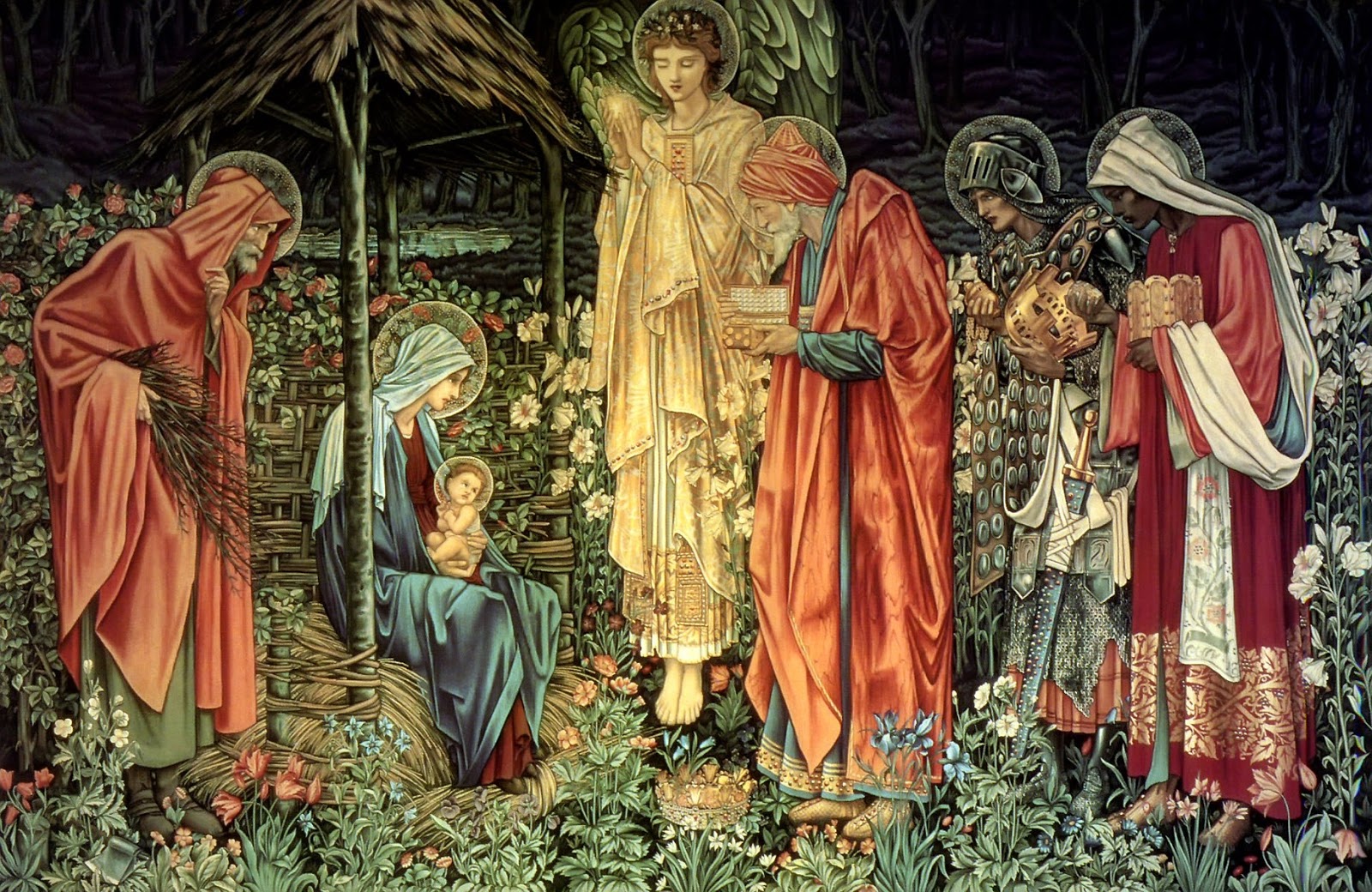
First Reading ( Isaiah 55:1-3) A reading from the Book of the Prophet Isaiah. Thus says the LORD: All you who are thirsty, come to the water...